In late 2021, as Europe stood on the abyss of war, its diplomats were still obsessing about climate change. At a meeting of the Organisation for Security and Co-operation in Europe (OSCE), the US ambassador, Michael Carpenter, was astonished to find his European colleagues still going on about climate change when ‘all I wanted to talk about was the risk of a full-blown war’.
That December, the OSCE asserted that climate change could ‘negatively affect prosperity, stability and security in the OSCE area’. The conclusion was praised by Britain’s ambassador, Neil Bush, who also spoke of the need to ‘mainstream gender across all dimensions of the OSCE’s work’. The Canadians, however, complained about OSCE’s weak language regarding ‘the disproportionate impact of climate change on women’. Twelve weeks later, Russia launched its full-scale invasion of Ukraine.
In his last interview weeks before his death in June, Sir Alex Younger, who led MI6 for six years, pushed back on the suggestion that Nato’s woes were Donald Trump’s fault. ‘We’ve been huge beneficiaries of an incredibly generous security guarantee from the United States,’ he told the Economist. ‘My strong view is that we’ve actually been infantilised by it.’
In The Times, Juliet Samuel says that the huge surge in immigration has broken finally broken the Treasury pro-migration dogma.
The Treasury model also doesn’t take into account services immigrants might need, such as school places. The Office for Budget Responsibility has started modelling this for interest’s sake, but its official forecast is largely required to assume that Treasury departmental budgets will be met. By contrast, the forecast does assume that more immigrants will generate more tax revenues.
They also get to bank revenue from visa fees, health surcharges and skills charges, a few billion a year, but don’t have to account for benefit costs once immigrants get leave to remain. That’s because this currently takes five years, which also happens to be the Treasury’s forecast horizon. Then there’s the question of dependants. The Migration Advisory Committee estimates that a dependant coming in with a care worker will cost the state £67,000, in addition to the £36,000 lifetime cost of the worker. But that’s just for an adult. A child costs more (not least, £7,000 per year in education from day one) but for some reason, no one has crunched those numbers.
What’s clear is that the Boriswave has conclusively broken the Blair-given Treasury dogma and various arms of government are struggling to figure out what should replace it. Mahmood’s shift illustrates the dilemma. For a year, she has been arguing for an urgent policy change for care workers. The cost of granting them leave to remain, and therefore benefits, on the original five-year timescale, she claimed, will be £10 billion.
For The Critic, Emily Jashinsky says that the Republicans must chart a path away from both MAGA and Establishment Republicans after the midterms.
But there are other lessons for Republicans, too. For instance, exit polls suggest corruption was high on voters’ list of concerns. They also point to a backlash against maximalist positions on data centres and artificial intelligence, both of which the Trump administration has embraced enthusiastically. A Republican in 2028 will likely need to carve out a path between the GOP establishment and Donald Trump’s version of MAGA, now that it appears his coalition is fractured and his personal brand is unpopular at best and toxic at worst.
This helps explain why Florida Governor Ron DeSantis moved to distance himself from the Trump administration ahead of election day, taking aim at its positions on the war, Big Tech and corruption. Having quietly carved out a critical position on several of these issues over recent months, DeSantis took the gamble of going public with a series of scathing criticisms. The timing was deliberate. In a victory lap on Wednesday, he slammed Republicans for voting against the release of the Epstein files and failing to ban congressional stock trading.
DeSantis is reading the tea leaves correctly. But the danger is that establishment Republicans will interpret the defeat as a mandate to resurrect the pre-Trump party, whose own brand of politics had become deeply unpopular. Former presidential candidate Nikki Haley was already making precisely this argument on NBC News as the results came in. “The biggest lesson is that when Republicans stay close to our policies of economic freedom, lower taxes, and smaller government, we win,” she argued. “We need to return to that, stop the distractions, and get back to work for the American people.”
In Conservative Home, Peter Franklin says that the Conservatives must not rest on their laurels as they head back up in the polls.
Shortly before Andy Burnham became Prime Minister, I argued that a snap election would be catastrophic for the Conservatives. It’s not that we hadn’t made some progress in the polls by that point, but it wasn’t enough to stop Kemi Badenoch from losing her position as the Leader of the Opposition — and, most likely, leader of the party. There’s still no room for complacency (and it would be better for us if Burnham doesn’t go to the country early) but a snap election, if it does happen soon, no longer guarantees our downfall as a major political party.
So if anyone tells you that the Kemi-naissance is nothing more than vibes, don’t believe them. We’re still a long way from where we need be, but the last 12 months have made the difference between inevitable decline and the realistic prospect of revival.
But here’s the thing: Kemi Badenoch still needs a new strategy. It’s not because the current one has failed. Rather, its success begs an all-important question: “what comes next?”.
Wonky Thinking
In his first of a two-parter on his Substack, Neil O’Brien shows eight ways that the government is pushing up migration from creating new legal routes to lowering salary thresholds for work visas. In his second part, O’Brien goes into detail on the consequences of the Home Secretary watering down her reforms to Indefinite Leave to Remain:
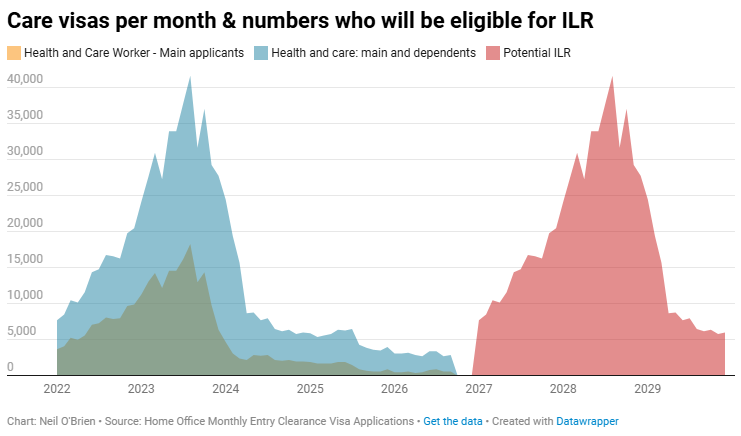
Just as a reminder, the reason Mahmood promised these reforms is that the huge numbers that arrived - particularly on low wage routes like the social care visa will become eligible for ILR during this parliament - five years after they arrived. The numbers eligible for ILR are effectively a shadow of the previous numbers arriving.
The blue area below is the number on the Health and Care visa - note that the majority of those who came on this visa were actually dependents, not main applicants.
Out of the 763,600 people who came on this route from 2022 to Summer 2026 most (470,800) were dependents. This is one of many reasons I have been so critical of it over the years.
Following Mahmood’s climbdown today these people will now be eligible to get ILR - which means they can get benefits and council housing - just five years after they arrived. To visualise that, I have shown the pink “shadow” below, which will ramp up later this parliament, putting even greater upward pressure on welfare spending.
The Migration Advisory Committee has said that the net lifetime cost to the taxpayer is likely to be £36,000 per care worker and £67,000 for each of their adult dependants. There are reasons to think this is too low, but still, everyone agrees there is a cost.
Podcast of the Week
On the Anglofuturism podcast this week, writer Ed West discusses whether Britain as a cultural entity has disappeared and argues that this focus on Britain obscures the solid foundations of England.