
Perusing a second hand book shop, I came across a small bright yellow book. Full Text of the Rome Treaty and an ABC of The Common Market (pictured below) by Paul Minet: journalist, bookseller and Liberal Party activist.
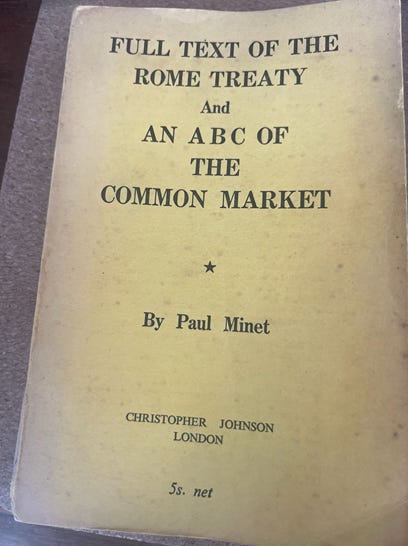
The book is interesting because whilst much of the discussion around Britain joining the European Economic Community (the Common Market) focuses on the early 1970s, this book was published in October 1961. This publication aimed to support Britain’s first negotiation, under Prime Minister Harold Macmillan, to join the Common Market.
The early 1960s are a strange time economically and socially, because unlike the unrelenting gloom of the next decade, this was in the midst of the economic ‘stop and go’ that led to periodic waves of optimism and pessimism. Britain in the 1970s was forced to join the EEC because it seemed like it had no alternative, but in 1961 there was still an argument to be had about the future.
The late 1950s had seen the government kick off an economic boom through an expansionist budget under Chancellor David Heathcoat-Amory, strongly urged by Harold Macmillan, to win the 1959 election. Tax cuts and generous investment allowances saw the economy grow by 13% between 1958 and 1961, with real GDP per capita growth peaking hitting 5.5% for the year in 1960. Annual capital investment increased by 30% and house income was nearly double what it had been in 1950. However, despite the historically impressive rates of growth, the fifties had been a disappointing decade where Britain felt the double punch of obvious overwhelming American superiority and the catch up of European powers. Something had to be done. Minet was well connected journalist and bibliophile, who wrote this book to try to make the case for joining the EEC, drawing on the key arguments of the political and economic establishment. In many ways, his book lays out the pattern for the past sixty years of debate.
Politicians today would obviously bite their arm off for economic fundamentals as strong as the ones that Macmillan presided over. Yet, once again a sense of overwhelming American superiority and European catch up growth is creating panic rather than a cold examination of our position.
Minet’s book is fascinating because just like today’s advocates for closer links (or rejoining) the European Union, the decision to look to Brussels is based on avoiding hard choices at home and trusting in the size and scale of the European market to cover up our structural problems.
The political inability to make hard choices comes home repeatedly in his analysis. Discussing what the British economy needed to succeed, Minet is clear “the solution is to trim costs to keep pace with productivity”. This means prioritising investment over consumption (household and public), a focus on exports and avoiding too much capital flight to prioritise the home economy. Reform of the trade unions and managing wage demands were also necessary. This programme “is perhaps the only cure to our present situation, if an internal cure must be found.” The problem is that such a programme “would not attract much support in the country” because it would necessitate short term sacrifices. To avoid this “austerity programme”, as Minet called it, Europe was the only viable way forward. We can see the same arguments being made today for why we need to consider rejoining or developing closer links with the European Union. Easier trade with Europe would increase trade, boosting GDP numbers. We can just ride on the coat tails of the larger market and we’ll be able to avoid structural changes to UK Plc which would likely be unpopular.
The sum of Minet’s argument is simple. In 1961, the growth markets of the future were in Europe. The Commonwealth countries were putting up tariff barriers and switching towards greater domestic manufacturing reducing the opportunities for Britain to export there. If Britain wanted to maintain its industrial and productive base, it needed to get access to the growing European market. The only danger was that European competitors, particularly West Germany, were seen as more productive and efficient than we were. The risk would be that if we joined the EEC, Britain’s manufacturers would get crushed. Minet’s view, like most of the establishment, was that it was worth the risk. Plus Britain needed a “cold douche of competition” anyway. Win-win. The size and depth of European markets has never been in question, then or now, but the real point is whether joining the EEC (or EU) would actually give Britain these benefits and competitive push that it required?
We have the advantage on Minet, because we have experience of what actually happened. The short answer is that it did create growth, but the type of growth was very different to what pro-EEC advocates had hoped for and was fundamentally unsustainable.
The assumption that Minet and the economic establishment were working on was that the British economy would be industrial and broad-based, not only to maintain employment in the nations and the regions but also because the UK would always be a net importer of food and raw materials (including fuel). Industry is the focus of Minet’s analysis, with services getting only a few infrequent mentions. This was not because of ignorance of the earning potential of services. As prominent economists Robert Bacon and Walter Eltis argued in 1976, and was standard for Minet’s time, the “various private-sector service industries make a valuable contribution to the balance of payments, but this has never been sufficient, and it is never likely to be to finance the food and raw materials that Britain must buy from overseas.” The EEC would be a success if it led to a sustained growth in goods exports which could be used to maintain our standard of living. Growth in services was to be encouraged and welcomed, but was not a substitute for a viable industrial strategy.
So what happened? In the years 1948 to 1973, the UK’s trade exports increased by around 6% in real terms. In the following twenty five year period, exports increased by only 2.6% in real terms. In the years leading up to the Brexit referendum and over the past few years since we’ve left, we’ve seen goods exports stagnate. The fact was that joining the EEC did provide the “cold douche of competition”, but we ended up running away from it, rather than embracing it. The robust industrial policies of European competitors, Germany in particular, forced the country into a transition towards a service-based economy to avoid direct competition with Europe, with Britain retreating to its niche strengths in services. The continent would be the industrial heart of Europe, we would be the services superpower. The alternative would have been more investment in infrastructure, supporting foundational industries such as steel and automotives, with relatively less household and public service consumption. All this would have required the country to make some hard choices.
Our reformed service-based economy temporarily benefited from an unreplicable expansion of financial service exports from the mid-1980s to the mid-2000s, a boom that eventually turned to bust and created a huge debt overhang which has crushed the economy ever since. Moreover, as Bacon and Eltis predicted in the 1970s, this service based growth was never enough to pay our way and finance investment. British households and private sector began to borrow heavily from overseas from the early 1980s until the financial crash to pay for our imports. After the crash, the government was forced to prop up the economy and take on huge public sector debts. Subsequent economic shocks, particularly the pandemic, have forced the state to set in again and again. The result has left the British economy financially exposed and, as Mark Carney infamously put it, dependent on the “kindness of strangers”. Ironically, despite the push for Europe in 1960s being fuelled by concern about America’s overwhelming power and Europe’s strengthening industrial base, we are more dependent on American finance and European goods than ever before.
We live in the political consequences of this gamble. The impact of deindustrialisation and hollowing out of communities has created a demand for social and political reform that has shaped every election since 2017. Old political loyalties have been shaken off and voters in these places have decided to embrace whatever political party that has a plausible programme for change, with huge swings in electoral fortunes as a result.
Minet’s book trades heavily on optimism about ‘expansion’ and how being part of the EEC will lead to the Europe coming together in a shared plan to counter American economic dominance. We know from our negotiations with Europe that although there is much talk about cooperation, EU members remain as protective over their domestic industrial base as they ever were, even when it concerns the military defence of the entire continent. Is it really likely that the EU is going to facilitate the rebalancing of the British economy when they would be losers in that process? Minet’s naivety can be forgiven, with all the soaring rhetoric of European unity during his day, but that of today’s advocate for rejoining the European Union cannot. We have seen golden words turn to ash too many times.
The question which Minet did not have to answer, but which today’s advocates of Europe must answer, is why would this time be any different? Like Minet, therefore, they must return to rhetoric, or ‘vibes’ as kids say today. The ‘model wars’ between various different pro and anti-Brexit all rather miss the point. What has happened since Brexit is immaterial. The point is what happened before Brexit. Here we are solid ground. It also provides the evidence for why we left the EU in the first place. The economic model of Britain simply was not working. The public could see it, even if the establishment could not.
We return full circle. Britain’s weak exports in goods, dependence on overseas food, raw materials and manufactured products alongside our inability to create decent employment (particularly for the young) across all parts of the country remain our central economic challenges. We can repeat the mistakes of Minet & Co, hoping that a dash for Europe will allow Britain to carry on without hard choices. Or we can finally undertake that difficult conversation with the public, lay out the true state of our weak financial and economic foundations, and ask the public for permission to introduce the policies needed to rebuild our industrial base and sustainable prosperity.
Minet thought that such a conversation could not be had, or if it was had, it would lead to electoral defeat. Perhaps Minet was right then and is right now. Yet the thought remains, isn’t it worth trying to do something different?
Full Text of the Rome Treaty and An ABC of The Common Market by Paul Minet (1961) can be found online or, if you are lucky, in your local second hand bookshop.