
Towering Columns
In UnHerd, Phoebe Arslanagic-Little documents how the NHS is failing mothers contributing to falling fertility rates in Britain and across Europe.
The UK’s total fertility rate is 1.41 and falling. A future of ever fewer children has serious social and economic consequences for us all. Making becoming and being a parent easier, tangibly improving the lives of parents, are clear ways in which we can help those who already want to be parents or have a further child to do so.
And that is what history tells us. By the 1920s, more than 50 per cent of Europeans lived in a country with a below replacement fertility rate. In 1935, the UK’s fertility rate had dropped to only 1.79. Then, the Baby Boom happened and people in countries all over the world began having more children and doing so earlier in life. There is strong evidence that better maternal medicine was a major contributor to the Boom. The widespread availability of blood transfusions and antibiotics made having a child significantly safer and so women became more likely to choose to become mothers or have a further child.
The experience that women have bringing children into the world matters, to those individual women and their partners and families, and to all of us as the need to make parents’ lives better increases. An NHS that believes aromatherapy, sterile water injections and relaxation techniques belong in the same category as highly effective analgesics like epidurals has gone down the wrong path.
In The Times, Melanie Phillips says that Europe needs to return to Christian civilisation in order to survive.
The enemies of the West understand the cultural vacuum that has developed and the opportunities it opens up for them. Vladimir Putin understands it very well as the collapse of European Christian civilisation. The problem is that he imagines himself as a latter-day Russian emperor leading the restoration of Christian Europe. This is held to justify his invasion of Ukraine and potentially the Baltic states too. Far from saving Europe, therefore, he menaces it.
In America, elements within Maga-world can’t grasp this baleful reality. Instead, they identify with Putin in what they credulously believe is a common defence of Christian civilisation. But those in Britain and Europe who are horrified by these Maga ultras should check their own hypocrisy. As Gordon Sondland, a former US ambassador to the EU, has said, it was Europe’s spinelessness that enabled Putin’s aggression.
Britain and Europe have long leeched off the US for military protection while trashing their own defences, along with their historic culture. The NSS warning, Sondland said, was a wake-up call intended to alarm Europe sufficiently to rearm itself and beef up its defences.
Only Britain and Europe can save themselves. That’s what the Trump administration is saying. That’s what Britain and Europe don’t want to hear.
In The Telegraph, Claire Coutinho calls for dropping the government’s clean power target to avoid deindustrialisation and bigger bills.
Britain simply cannot afford to spend the next 25 years with uncompetitive electricity prices. We would continue to deindustrialise, miss out on the economic growth opportunities of AI, and see living standards suffer. Britain’s prosperity derives from our ability to be at the forefront of successive industrial revolutions.
The AI revolution is happening now. If we do not address the cost of our electricity in the immediate term, Britain will fall behind the technological curve for the first time in two centuries and we will be poorer because of it.
The report is also explicit that overbuilding wind power, as the Government plans to do, will mean costs go up as we pay first to build the wind farms, and then pay again to turn them off when it’s too windy. That’s why I’ve been arguing Ed Miliband’s Clean Power 2030 mission, far from saving billpayers £300 as promised in the General Election, is going to cost consumers a bomb whilst multi-million-pound wind developers laugh all the way to the bank.
In Conservative Home, Sir John Redwood argues that Britain would be foolish to ignore Trump’s call for Europe to change course.
How should the UK respond to this underlining of the US approach? There is nothing in the document that should come as a surprise to observers of the presidency. It should encourage Britain to believe in itself, to see and seize the opportunities of Brexit more clearly, and lead the Government to make faster and better provision for a stronger military to take care of our own defence. We need an enhanced shield against incoming drones, missiles and aircraft, stronger defences against interference in our waters, and more attention to cyber warfare and drone technology. It should also persuade ministers to take more urgent and effective action to cut illegal migration. We also need to examine drug dependency and drug trades into the UK as we too like the US have too many people with a serious drug dependency.
It is difficult to know how to handle the breakdown in relations between the EU and the US. The UK agreeing to provide practical military support to help police a Ukraine settlement is currently not relevant, as there is no peace to police and Russia is against European states putting military personnel onto Ukraine soil. The Government is right to rule out committing British forces to fight Russia on the side of Ukraine – but this decision means we should not try to change Ukrainian views over the peace or its commitment to the war, as they are the ones that have to bear the pain and the losses.
The Government is right too not to rush to reply in detail to this extraordinary statement. When an ally speaks out like this it is best to do what we think is right and to let our actions speak rather than any critical words. The message that we need to take more care of ourselves is one we should not ignore.
In The Telegraph, Lord David Frost writes that the left are debasing British culture to undermine support for the nation state.
This ideology asks us to idolise a vision of tolerant, diverse people in strong communities celebrating their differences. But even the Left can see that tolerance, diversity, and equality are firstly not uniquely British, and secondly far too abstract to get emotional about.
So, to bed them in, they have to be given a specific British quality. And since the Left rules out of court all the traditional elements of national identity, all they are left with is this debased version: Paddington the refugee, “meal deals and Mr Blobby”, British greatness encapsulated as a montage of Chicken Shop Date and Sam Fender hungover on breakfast TV.
It isn’t good enough. This isn’t patriotism. It’s a pathetic retreat into kitsch, politics as soft play, a denial of the country’s challenges, even at some level a rejection of the view that those challenges are important because all we need do is be nice to each other. Those of us who still believe in the nation state, in its British or any other version, and who think our civilisation is worth preserving, must not be tempted to go down this road. Instead we must get back to meaningful patriotism, to serious stuff, to this country’s contribution to Western achievements and the things that make this country distinctive.
In The Financial Times, Janan Ganesh says that the world does not face a conflict between civilisations but a clash within civilisations.
Before he died in 2008, Samuel Huntington could have said “I told you so” without too much dissent. The US was then several years deep into its missions in Iraq and Afghanistan. Such violence between the western and Islamic worlds seemed to vindicate the Harvard scholar, who had once segmented the globe into civilisations and predicted a clash of them. As our troubled millennium got going, the word “prescient” followed him around like an extra name.
It is crass to speak of such a thing as a well-timed death. Had he lived to this day, however, Huntington would be taking as much flak as poor Francis Fukuyama does for getting the world all wrong. The important conflicts now are within, not between, civilisations. The C-word has seldom been so popular (the US government talks about Europe’s “civilizational erasure”) and so useless.
Look at the world’s trouble spots. The war in Ukraine is a war within the “Orthodox” Christian civilisation, at least as Huntington classified it. The periodic stand-off between the People’s Republic of China and Taiwan is another example of a tussle inside a cultural bloc — what Huntington called the Sinosphere. A candidate for the deadliest current conflict on Earth, Sudan’s civil war, does not pit a coherent religious or cultural group against another, as such. Even the external patrons of the combatants, which include the UAE on one side and Egypt on the other, are mostly from within the Islamic world rather than distinct civilisations.
In The Telegraph, Nile Gardiner says that the US is right to work with allies in Europe nations to weaken the power of Brussels.
The EU is a real problem for the United States and for the transatlantic alliance. It is dominated by big government, Left-wing ideology, and is sinking under the weight of decades of open-borders policies, threatening the very future of Western civilisation. As Trump and his vice-president JD Vance have made clear, Europe faces an existential crisis of its own making, while adversaries such as China and Russia are seeking to exploit Europe’s weakness.
It is in America’s national interest to work with sovereign nation states that share its values, and are based on democratic accountability. As Musk has declared, “The European Union is not democracy – rule of the people – but rather bureaucracy – rule of the unelected bureaucrat.”
Obviously, the United States cannot unilaterally abolish the EU, which was originally established as the European Coal and Steel Community in 1951 with American support. But it can actively back the cause of national sovereignty and self-determination across Europe, challenging the power of Brussels, and stand with European movements that seek to throw off the shackles of the EU machine.
Wonky Thinking
Rian Chad Whitton has published a new report for the The Prosperity Institute detailing how Net Zero is destroying the our industrial foundations.
Given the dire straits of Britain’s energy-intensive industries and the expectation of significant turbulence in the global economy going forward, it is clear why governments feel compelled to offer industry exemptions and even subsidies for energy prices, and to takeover failed operations like British Steel and Speciality Steels. However, these are reactive measures that do not alleviate the largely self-imposed conditions of decline. Time is running out to change the course of Britain’s deindustrialisation. Improving British electricity price competitiveness will take between five and ten years, but large sections of the energy-intensive industries could be severely diminished within just 24 months without course correction.
Any government support for industry must be supplemented by a real plan to improve industrial competitiveness, prioritising low energy costs, reducing and removing onerous regulations, and cutting back self-defeating mandates. Approval of active industrial policy has to be contingent on supply-side reform.
British government policy can immediately be improved at the conceptual level. The Office for National Statistics annually provides estimates for the LCREE. This collection of industries is prioritised through Government policy in the form of subsidies, levies, research grants and direct funding. Yet it has a small turnover of £70bn versus over £200bn for the foundational industries. From now on, the energy-intensive sector should take priority over the green sector when considering government targets for revenue growth and improving prosperity outside of London.
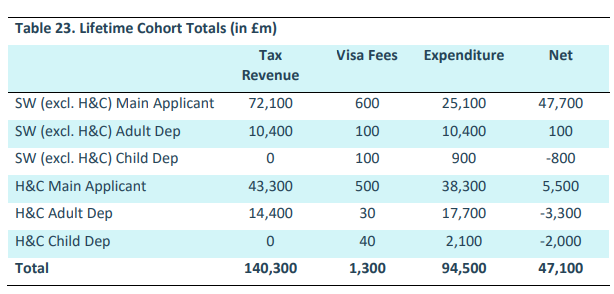
The Migration Advisory Council has published a report on The Fiscal Impact of Immigration: Static and Dynamic Estimates for the UK which estimates the contribution of migrants.
Overall, the SW [Skilled Worker] visa route is clearly fiscally positive for the UK. This is almost inevitable given that main applicants on the route must have a job offer paying above a set of salary thresholds. This means that these migrants have higher employment rates than UK residents since employment is a condition of the visa and as we shall demonstrate, salaries on the SW route are significantly higher than UK average wages. For the 2022/23 cohort as a whole, we estimate a present value net fiscal contribution of around £47bn over their lifetime. However, this estimate hides very substantial heterogeneity. The entire positive contribution comes from main applicants – particularly those outside of H&C [Health & Care]. Dependants have relatively small overall lifetime contributions which are negative in aggregate. Furthermore, even within the highly positive SW (excl. H&C) main applicants, 72% of the fiscal gain comes from the top 30% of earners.
More broadly our results highlight two key determinants of fiscal contribution over the lifetime for migrants. First, the age at which the migrant arrives in the UK. Migrants are typically aged in their 20s and 30s when they arrive, and this is an age at which the future lifetime contribution is most likely to be positive since it avoids the fiscal costs of childhood and allows for a substantial period in the labour market to make significant tax contributions. To put this £47bn figure in context, the present value of total government spending over the lifetime of this cohort is estimated to be around £26,700bn.
Second, the employment rate and wages that migrants achieve. Those who arrive on sponsored work routes are more likely to be fiscally positive, whilst the contribution of their dependants (adult partners) will depend on the extent to which they work and the wages they receive. Visa routes that do not have work requirements will therefore generally be less fiscally positive (or be fiscally negative) than the results reported here for the Skilled Worker cohort. Furthermore, just like for UK residents, fiscal contributions are heavily skewed toward high earners given the progressive tax system. This highlights the importance from a fiscal perspective of attracting global talent and creating a policy environment than encourages such workers to remain in the UK.
This table summarises the estimated lifetime totals for migrants arriving in 2022/23.
Podcast of the Week
Professor Dieter Helm discusses the reasons why our economy has struggled to grow in his latest podcast. Helm argues that Western economies, especially the UK, prioritise consumption over production, rely heavily on welfare spending, and maintain incentive systems that discourage work.
Quick Links
The economy contracted by 0.1% in October.
The economy is smaller today than it was before the pandemic.
British taxpayers pay more income tax than French taxpayers.
Fewer than a quarter of grooming gang suspects were arrested last year.
Four in ten asylum seekers remain in Britain despite being rejected.
The First Sea Lord says Britain is close to losing the Atlantic to Russia.
The CBI says Rachel Reeves’ tax rises are driving up unemployment.
Experts say we cannot fight a war lasting longer than a few weeks.
China’s trade surplus with the rest of the world has passed $1 trillion.
The UK’s former Head of Nuclear Policy says our nuclear submarine fleet is ‘no longer fit for purpose’.